Open Today Sales: 8:30 AM-7 PM
Open Today Service: 7:30 AM-5 PM



When it's time to introduce your garage to the benefits of an all-electric commuter, a Chevy Bolt vs. Nissan Leaf comparison can help you make the choice that best suits your needs. The upcoming Chevy car is a clear choice for anyone looking to get their first EV without sacrificing style, charm, or interior comfort. However, if you've been thinking about driving a Nissan Leaf around roads in Jacksonville, FL, we want to assure you that the Chevy Bolt is worth the wait.
As this model rolls into our Nimnicht Chevrolet showroom, it promises to give a level of comfort, security, and style that the Nissan equivalent can't emulate.
| Chevy Bolt | Nissan Leaf | |
|---|---|---|
| Motor | Single permanent magnetic drive | AC synchronous motor |
| Horsepower | 210 | 214 |
| Torque | 169 lb-ft | 261 lb-ft |
| Drivetrain | FWD | FWD |
| Estimated Range | 255 mi2 | 259 – 303 mi3 |
| Charging Times |
|
|
| Length | 169.6 in | 173.4 in |
| Width | 69.7 in | 71.3 in |
| Height | 63.9 in | 61.3 in |
| Headroom (Front / Rear) |
|
|
| Legroom (Front / Rear) | 44.3 / 39.1 in | 42.4 / 31.8 in |
| Cargo Volume (Min / Max) | 16.2 / 56.3 cu ft | 20 / 55.5 cu ft |
| Feature Highlights |
|
|
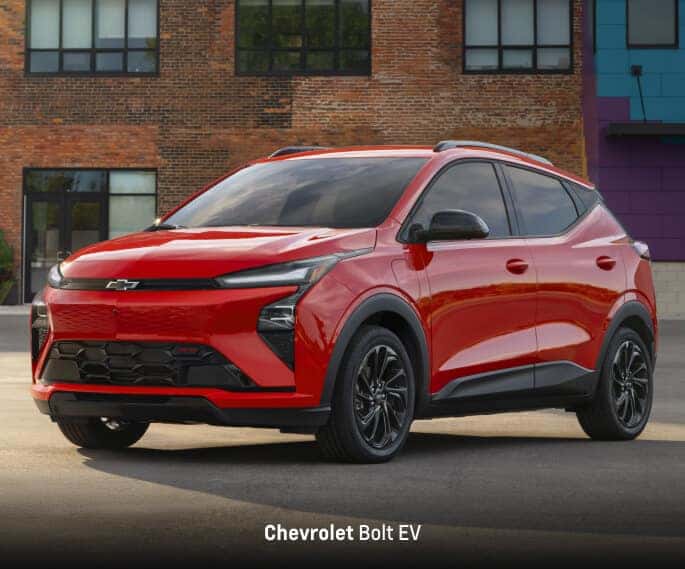

The first step of our Chevy Bolt vs. Nissan Leaf comparison covers the motors. The Chevy Bolt's single permanent-magnet drive motor prioritizes ease of maintenance and repair over the AC synchronous motor of the Nissan Leaf, giving the 214-horsepower Leaf a minor edge in power and range. The Chevy Bolt isn't far behind, with a range of 255 miles,2 which is perfect for daily commutes and after-school activities.
Where the Bolt shines in this category is charging time. It saves time at Level 2 charging stations with an NACS connector thanks to its 40 miles-per-hour charging speed.1 The difference is more stark at Level 3 stations, where the Bolt gets back to 80% charge nine minutes faster than the Leaf (26 minutes vs. 35 minutes)1, 4 Shop our Chevy EV inventory to see just how easy it is to recharge and get back on the road with an all-electric Chevy vehicle.
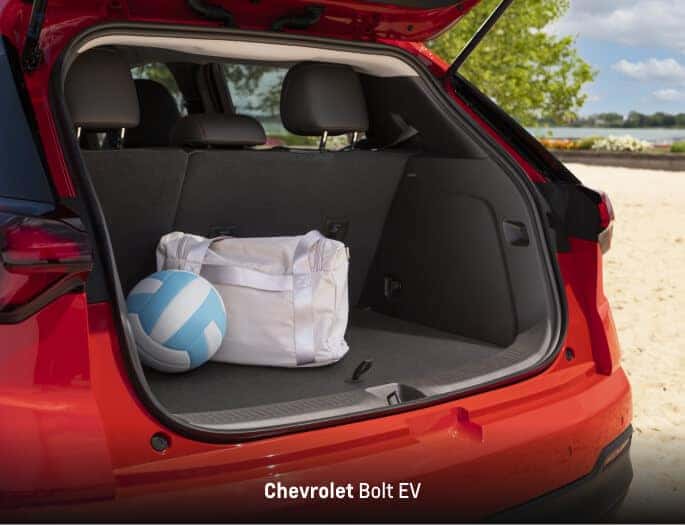

Interior space is the domain of the Chevy Bolt. It's the shorter model, at 169.6 inches (vs. the 173.4-inch Nissan Leaf), so you'd think it had a smaller cabin. And yet, if you climb into the front or the back of the Chevy Bolt, you're in for a comfortable ride. Front-row passengers get up to 44.3 inches of legroom, while rear-row passengers get 39.1 inches of legroom. Compare that to the Nissan Leaf (with 31.8 inches of rear legroom), and the difference is night and day.
Cargo space is a closer battle. The Nissan Leaf has slightly more trunk space, but the Chevy Bolt adds a small amount of room when you fold the rear seat down (56.3 vs. 55.5 cubic feet).
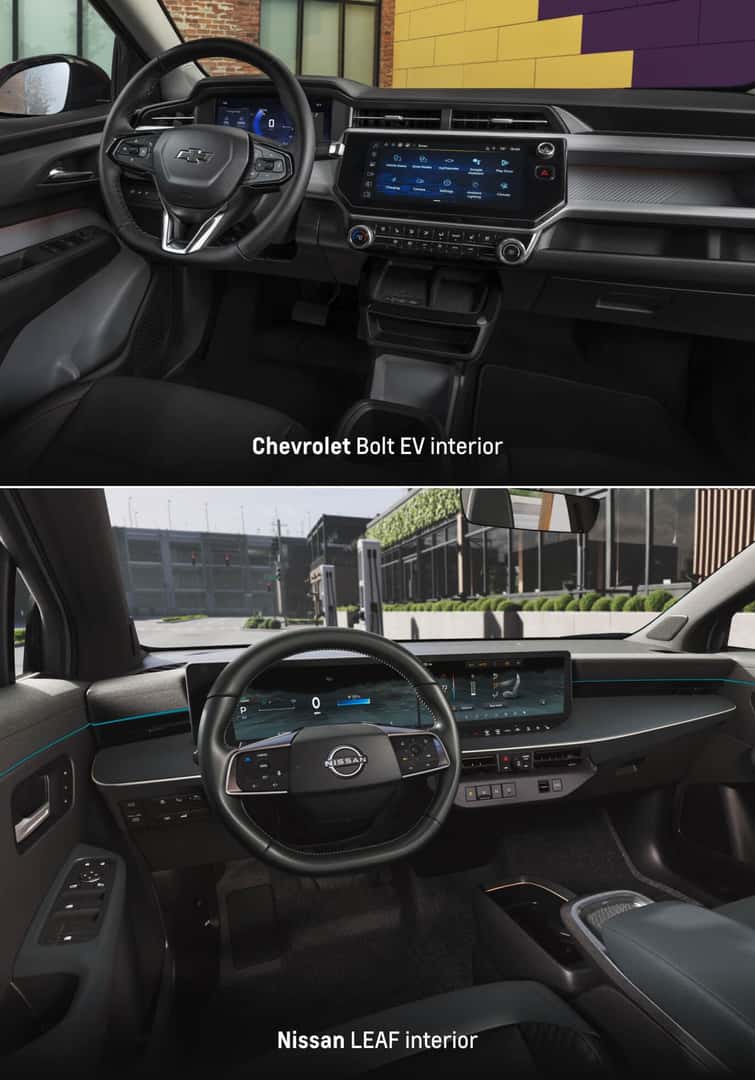
The last section of our Chevy Bolt vs. Nissan Leaf comparison is technology. While we don't have every tech feature for the upcoming Chevy model, we know that it will stay competitive. The Nissan Leaf has a bit more screen space, but the Chevy Bolt comes standard with synthetic leather seating. Where the Bolt has the edge is in safety, thanks to technology like Super Cruise. As we approach the Chevy Bolt release date, we'll have more information about the cabin's technology.
Conveniently, you'll get the full suite right away. There are only two Bolt trims: the standard LT and the RS, which adds sport style. The Nissan Leaf has three trims (S+, SV+, and Platinum+), so you may have to pay more to access the features you want.

We've been fans of the Chevy Bolt since its release in 2016, so seeing it making a return has us excited! Those huge rear seats are perfect for passengers of every size, and the Bolt's range will be plenty for a week of commuting with minimal charging in between. As big EV heads, we're happy to see another affordable option join our lineup, and we encourage you to try the 2027 Chevy Bolt once it rolls onto our lot: you won't be disappointed.
Scott Garman, General Sales Manager

goldblumspowerbook
I've had both, range and battery matter. The leaf is comfortable but the bolt is way more fun to drive. It depends what you like. When it comes to battery range and longevity, bolt is the way to go.
Read More
phoundog
As a current Bolt owner and former LEAF owner I welcome this development! Sounds like an excellent revamp.
Read More
milo_hobo
I'm happy to see more competition in this segment, but there are some very good reasons to choose the new Bolt.
Read More2026 Nissan Leaf: Serious Competitor To The New Bolt? byu/Razzburry_Pie inBoltEV
The primary differences between the Chevy Bolt and Nissan Leaf are size and comfort. While the Nissan Leaf is the larger model in external dimensions, the Chevy Bolt provides nearly 2 inches of extra front legroom and more than 7 inches of extra rear-row legroom (39.1 inches for the Bolt vs. 31.8 inches for the Leaf). Both vehicles are otherwise quite competitive with one another.
The Chevy Bolt has a driving range of approximately 255 miles,2 which is almost equivalent to the driving range of the Nissan Leaf Platinum+ trim's 259 miles.3 While the Nissan Leaf does have slightly more overall range (up to 303 miles),5 the Chevy Bolt has a faster Level 2 and Level 3 charging speed, compensating on roadtrips and at home stations alike.
The most significant factors you should pit against one another are interior comfort versus range. The Chevy Bolt is significantly more comfortable in the front and back than the Nissan Leaf, but the Leaf offers a modest amount of additional all-electric range. As long as you charge regularly, the Chevy Bolt is the bolder, more accessible entry point to all-electric technology.
1Actual charge times will vary based on battery starting state of charge, battery condition, output of charger, vehicle settings and battery temperature. See the Owner’s Manual for your vehicle and charger for additional details & limitations.
2EPA-estimated 255-mile EV range. Your actual range may vary based on several factors, including temperature, terrain, battery age, and how you use and maintain your vehicle.
32026 EPA estimated range of up to 259 miles for Nissan Leaf Platinum+ for combined city / highway driving. Based on EPA formula of 33.7 kWh equal to one gallon of gasoline energy. Actual range will vary with trim levels, options, and driving conditions. See Customer Disclosure Form for details. Use for comparison only.
4Charging time and capacity may vary based on power source, ambient temperature, battery temperature, condition, age, and use of vehicle accessories while charging. For Level 1 home charging use only a 110-120 volt, 15-amp dedicated outlet for charging. For Level 2 home charging use only a 240 volt charging dock on a dedicated outlet. See Customer Disclosure Form for details.
52026 EPA estimated range of up to 303 miles for Nissan Leaf S+ for combined city / highway driving. Based on EPA formula of 33.7 kWh equal to one gallon of gasoline energy. Actual range will vary with trim levels, options, and driving conditions. See Customer Disclosure Form for details. Use for comparison only.